
Golf Betting Guide 2026: Odds, Bet Types & Winning Strategies
 Available in US
Golf betting occupies a peculiar space in the sports wagering landscape. Unlike football or basketball, where favorites win more often than not, golf tournaments regularly produce winners at 50-to-1 or longer odds. The sport rewards patience,
research, and a fundamentally different approach to bankroll management than most bettors are accustomed to. Since the Supreme Court’s 2018 decision allowing states to legalize sports betting, golf wagering has experienced remarkable growth
as fans discover what sharp bettors have known for decades: golf offers some of the most compelling betting value in all of sports.
What makes golf betting unique starts with the competition structure. A typical PGA Tour event features 144 players competing over four days, with roughly half the field eliminated after the second round. This large field size means even the
best player rarely wins more than a handful of tournaments per year. When Scottie Scheffler dominated the 2024 season with seven victories, it was considered one of the greatest seasons in modern history, yet he still won less than 25
percent of events entered. This inherent unpredictability creates betting opportunities that simply do not exist in other sports.
The growth of golf betting also reflects changes in how Americans consume sports. Legal sportsbooks now operate in the majority of U.S. states, and golf has emerged as one of the most popular betting sports. The PGA Tour season runs nearly
year-round, meaning there are typically two to four professional tournaments to bet on during any given week. Television coverage has expanded significantly, and streaming services make following tournaments in real time easier than ever.
This accessibility matters for live betting, which has become increasingly popular among golf bettors who enjoy adjusting positions as tournaments unfold.
Perhaps most importantly, golf betting offers something that appeals to serious sports bettors: the opportunity to find genuine value. Because fields are large and outcomes difficult to predict, sportsbooks face challenges setting accurate
lines. A bettor who studies course history, analyzes strokes gained statistics, and understands how player skills match specific course demands can identify mispriced players the market has overlooked. This guide provides everything you
need to understand golf betting in 2026, covering odds formats, bet types, major tournaments, strategy fundamentals, live betting, and sportsbook selection.
Comparing Golf Betting Odds
How American Odds Work in Golf
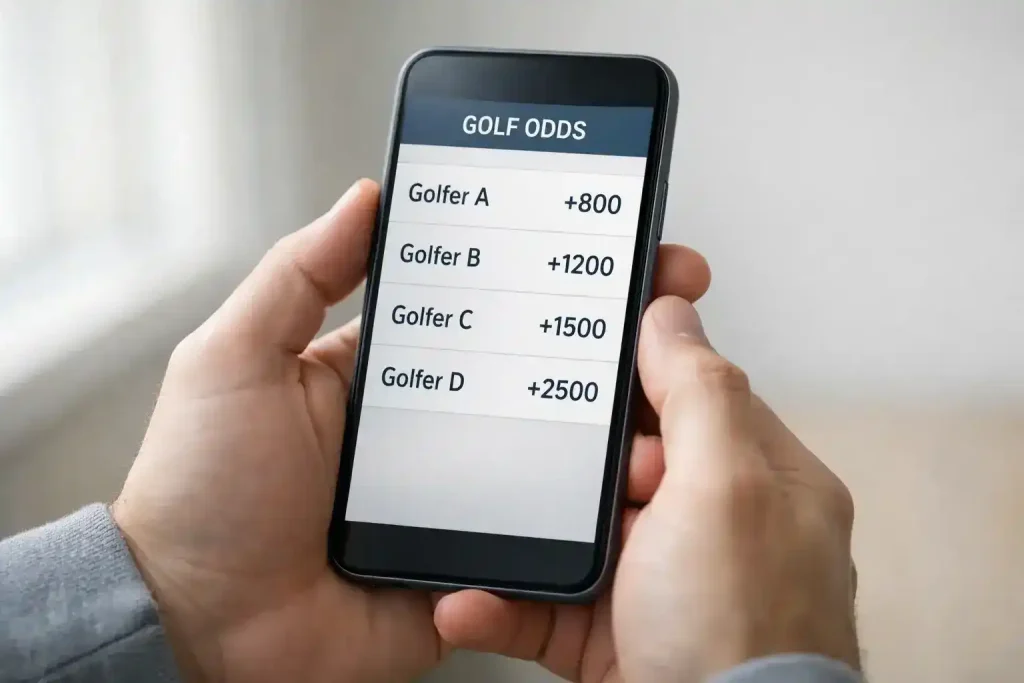
Before placing any golf bet, you need to understand how odds work. In the United States, sportsbooks use American odds expressed as positive or negative numbers relative to 100. The critical difference between golf and most other sports is
that golf favorites almost always have positive odds, meaning even the tournament favorite is unlikely to win more often than they lose.
When you see a player at +800, a 100-dollar bet returns 800 dollars profit if they win, plus your original stake. Players at +2500 return 2,500 dollars on a 100-dollar bet. The larger the positive number, the less likely the sportsbook believes
that player is to win. Negative odds in golf typically appear only in head-to-head matchups rather than outright markets. A player at -150 means you need to bet 150 dollars to win 100 in profit.
Converting Odds Formats
While American odds dominate U.S. sportsbooks, you may encounter fractional odds (UK) or decimal odds (Europe/Australia). Fractional odds show profit relative to stake: 10/1 returns 10 units profit per unit wagered, equivalent to +1000 American.
Decimal odds represent total return including stake: 11.00 decimal returns 11 dollars total per dollar wagered, equal to +1000 American.
For decimal odds of 2.00 or higher, subtract 1 and multiply by 100 to get American odds. For decimals below 2.00, divide 100 by (decimal minus 1) and add a minus sign. Most sportsbooks let you toggle between formats, but understanding conversions
helps when comparing odds across platforms.
Implied Probability in Golf Betting
Odds represent probability, and calculating implied probability helps identify value. For positive American odds, the formula is: 100 divided by (odds plus 100). A player at +3000 has implied probability of 100/3100, approximately 3.2 percent.
If your analysis suggests this player has a 5 percent chance, you have potentially found a value bet.
Value betting is central to long-term profitability. Because no one predicts golf with certainty, success comes from consistently finding bets where your assessed probability exceeds implied probability. Professional bettors think in expected
value rather than individual wins and losses. This framework distinguishes serious handicappers from recreational gamblers.
Types of Golf Bets Explained
Outright Winner (Tournament Winner)
The outright winner bet is straightforward: pick who wins the tournament. Despite its simplicity, outright betting requires careful consideration because large fields mean even excellent players win infrequently. A golfer winning 5 percent
of tournaments entered would be among the world’s best, yet betting on them yields losses 95 percent of the time. This reality shapes how experienced bettors approach outrights: they accept most bets will lose while aiming for the occasional
large payoff to generate overall profit.
Odds for outrights release early in the week and fluctuate based on betting volume, injury news, and weather forecasts. Favorites at majors might open around +800 to +1200, while the same players at weaker events could be +400 to +500. Longshots
fill out the bottom of odds boards at +10000 or longer. The key distinction for outrights is that playoffs determine winners rather than ties. If players finish regulation tied, they play extra holes until one emerges victorious. This
means outright bets never result in dead heats, unlike placement markets.
Timing your outright bets matters. Early-week odds often offer value before the market sharpens, but you risk betting on players who might withdraw or struggle with undisclosed injuries. Some bettors prefer waiting until closer to first tee
times when more information is available about conditions and player form during practice rounds. Neither approach is universally superior; both involve tradeoffs between information and odds quality.
Top Finish Bets (Top 5, Top 10, Top 20)
Top finish markets offer alternatives to all-or-nothing outrights. Instead of needing your player to win, you need them to finish within a specified position range. A player at +5000 to win outright might be +200 for top 10 or even money for
top 20. These shorter odds reflect the higher probability of the outcome occurring.
Top 20 bets at modest plus-money can provide steady returns that build bankroll over time, though excitement is considerably lower than sweating an outright on Sunday afternoon. Top 5 bets occupy a middle ground with better odds but less frequent
cashes. Top 10 markets balance reasonable odds against decent probability, making them popular among bettors seeking a mix of return potential and win frequency.
Many successful bettors build weekly cards around top 10 and top 20 bets supplemented by selective outright shots. This structure provides a foundation of consistent returns while maintaining exposure to big paydays. Dead heat rules apply
to all top finish markets, a crucial consideration covered later in this guide. When multiple players tie for positions straddling your bet boundary, payouts are reduced proportionally.
Matchup Bets (Head-to-Head)
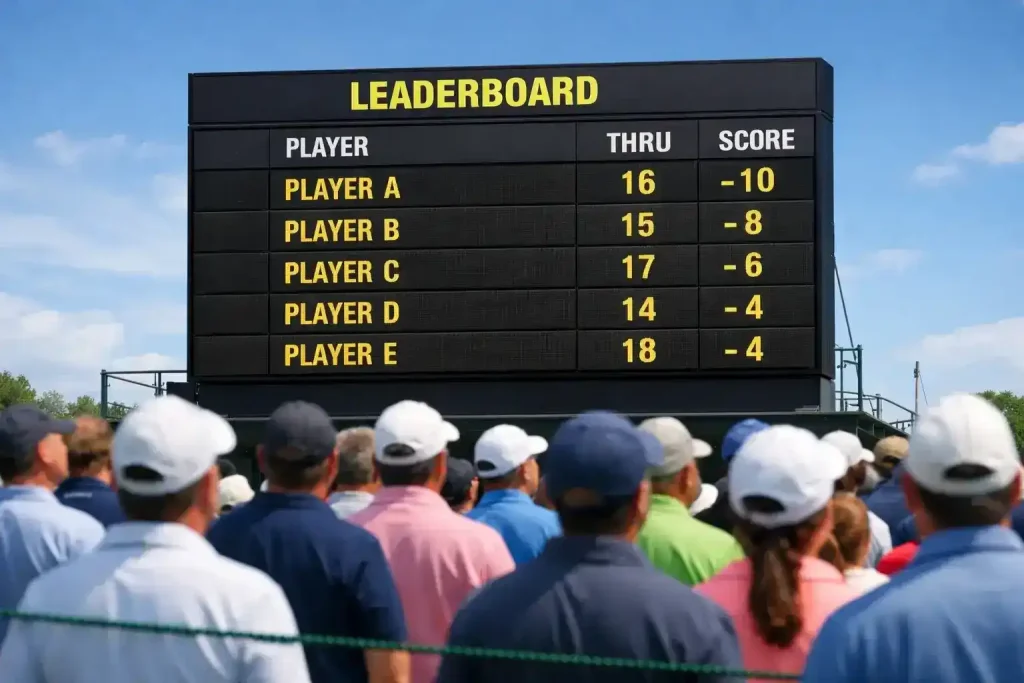
Matchup betting removes full-field unpredictability by focusing on just two or three players. In head-to-head matchups, bet on which of two players finishes with the lower tournament score. Three-ball matchups extend this to three players
paired together for a particular round. This structure significantly reduces variance compared to outrights while still requiring golf-specific analysis.
If both players miss the cut, most sportsbooks use 36-hole scores to determine the winner, though some void such bets entirely. Always verify missed cut policies before betting matchups because policies vary between operators. Round-by-round
matchups settle daily, eliminating missed cut concerns but requiring you to win multiple bets throughout the week for meaningful returns.
The appeal lies in leveraging player-versus-player analysis without needing to beat 143 other competitors. If you believe Player A is a better fit for the course than Player B, bet that opinion directly. Matchup betting is often recommended
for newcomers because it approximates familiar binary outcomes from other sports while introducing unique golf betting aspects like course fit and form evaluation.
First Round Leader (FRL) Bets
First round leader betting asks you to identify who holds the outright lead after Thursday’s round. FRL odds mirror outright odds but settle after one day, meaning extreme variance but substantial potential payouts. The compressed timeframe
creates a high-risk, high-reward proposition that attracts recreational bettors seeking excitement.
Several factors beyond player quality influence FRL outcomes. Tee times matter because morning players often face calmer conditions than afternoon groups at coastal courses prone to wind. Aggressive players who make birdies in bunches are
better FRL candidates than consistent grinders who rarely shoot very low or high. Course setup for Thursday rounds is typically the easiest configuration before superintendents firm conditions, which affects scoring patterns and favors
low-ball scorers.
Dead heats are common in FRL markets since ties for the lead after 18 holes happen regularly. When multiple players share the lead, all win the FRL bet, but your payout is divided according to dead heat rules. A three-way tie on a bet that
would have paid +5000 results in a significantly smaller return. Many sharp bettors avoid FRL markets despite their appeal, viewing dead heat risk as too significant for the offered odds.
Each-Way Betting
Each-way betting combines two bets: one on the player to win outright, one on them to place (typically top 4, 5, or 6). The place portion pays at reduced odds, usually one-quarter or one-fifth of outright odds. This structure originated in
British horse racing and remains popular with UK-based golf bettors, though American sportsbooks increasingly offer it.
If you bet 10 dollars each-way at +2000 with one-quarter place odds and top-5 place range, you risk 20 dollars total. If the player wins, you collect on both bets: 200-dollar win profit plus 50-dollar place profit. If they finish third, you
lose the win bet but collect 50 dollars on the place portion, netting 30 dollars profit after deducting your 20 dollars stake. If they finish sixth, both bets lose.
Each-way can offer value for consistent performers who frequently finish near the top without winning. However, comparing against separate outright and top finish bets on the same player is essential. Sometimes placing individual bets offers
better expected value than combining them each-way. The analysis depends on specific odds offered and your assessment of win versus place probability for that player.
Props and Specials
Proposition bets cover outcomes beyond finishing positions. Make/miss cut requires predicting whether a player survives to weekend rounds, appealing when you have strong opinions about a player’s floor but less confidence in their ceiling.
Borderline players facing courses that expose weaknesses or suit them poorly make particularly interesting cut market targets.
Hole-in-one betting offers long odds on whether any player makes an ace during the tournament. Some sportsbooks offer player-specific hole-in-one bets at even longer odds. Winning margin props predict whether the tournament ends in playoff
or by specific stroke margins. Wire-to-wire winner bets require a player to hold at least a share of the lead after every round, a rare occurrence commanding substantial odds.
Nationality props bet on which country’s player finishes highest. Top American, top European, top Asian, and similar markets let you leverage knowledge about regional player form and course suitability. These props are particularly interesting
at international events or majors attracting strong multi-tour fields.
Futures Betting
Futures are placed well in advance, sometimes a full year ahead. Common golf futures involve major championships and season-long awards like the FedEx Cup. Futures odds are longer than week-of odds because you accept additional uncertainty
and tie up capital for extended periods without knowing if your player will even compete due to injury or other circumstances.
The advantage is capturing value before the market sharpens. A player heating up before the Masters will see week-of odds shorten, while futures bettors who anticipated improvement already hold tickets at longer prices. The disadvantage is
that injuries and form slumps can render futures worthless before events begin. Season-long futures like the FedEx Cup add complexity because they depend on consistent performance across dozens of events rather than a single tournament.
Golf Betting Markets and Tournaments

PGA Tour Betting
The PGA Tour serves as the primary focus for most golf bettors, offering 40-plus events annually. The schedule begins in January with Hawaii and the West Coast swing, moves to Florida in spring, then features major championships interspersed
throughout: Masters (April), PGA Championship (May), U.S. Open (June), and Open Championship (July). The regular season concludes in August with FedEx Cup playoffs, followed by fall events counting toward the following season.
Standard events feature 144-player fields cut to approximately top 65 and ties after 36 holes. The cut line varies weekly based on scoring conditions and field composition. Signature Events introduced in 2024 feature smaller 70-80 player fields
with no cut, carrying enhanced purses and FedEx Cup points while attracting the strongest non-major fields. These events fundamentally change betting dynamics since every player completes 72 holes regardless of early-round struggles.
Understanding field strength is essential because it directly affects odds. A player at +3000 in a Signature Event faces stiffer competition than the same odds at a weaker fall event with many lesser-known players. Recognizing this context
helps evaluate whether odds accurately reflect chances relative to that specific week’s competition. Some bettors specifically target weaker-field events where identifying value among lesser-known players becomes possible through statistical
analysis.
Betting on the Majors
The four majors generate the highest betting volumes and each has distinct characteristics affecting strategy. The Masters at Augusta National rewards course history since it is the only major at the same venue yearly. Augusta’s slick greens,
significant elevation changes, and strategic approach angles favor players with exceptional touch and shot-shaping ability. Past performance at Augusta provides unusually reliable predictive value because the course does not change, unlike
rotating major venues.
The PGA Championship tends to favor length and power with wide fairways and heavy rough. Bombers who can attack from any lie often excel. The U.S. Open takes the opposite approach with narrow fairways, deep rough, and firm greens punishing
mistakes severely. Grinding pars matters more than making birdies at most U.S. Opens, favoring patient players with excellent course management over aggressive scorers.
The Open Championship introduces links conditions including firm turf, unpredictable winds, and creative shot-making requirements fundamentally different from American target golf. Players comfortable with low running shots, wind management,
and recovery from pot bunkers hold advantages over those whose games are built purely for American-style aerial golf. International players with links experience often outperform their typical PGA Tour results at The Open.
Other Golf Betting Opportunities
The DP World Tour (formerly European Tour) features events primarily in Europe, the Middle East, and Asia. Many top players compete on both tours, while others focus primarily on Europe. Markets are readily available though with less depth
than PGA offerings. The European schedule provides betting opportunities during American winter months and offers different course types that reward different player profiles.
LIV Golf has transitioned to a 72-hole format for 2026, moving away from its original 54-hole structure. The league features shotgun starts and both individual and team competitions. The smaller fields (around 54-57 players) and no-cut format
change handicapping approaches since every player completes all four rounds regardless of early performance. This creates different betting dynamics; slow starters face no cut elimination, while the format now aligns more closely with
traditional professional golf events.
Team events like the Ryder Cup and Presidents Cup create unique betting opportunities unavailable during regular tournaments. Match play formats reward different skills than stroke play, and the intense atmosphere affects player performance
in unpredictable ways. Markets include overall team winner, session winners, individual match outcomes, and various props. The Ryder Cup generates enormous betting interest due to passionate atmospheres and national pride implications
that transform typically calm professionals into emotional competitors.
Dead Heat Rules Explained
What is a Dead Heat?
A dead heat occurs when multiple players tie for a position that determines whether a bet wins or loses. This happens frequently because golf does not use tiebreakers for positions other than first place. If three players finish at 10-under
par tied for 10th, all three occupy that position simultaneously. If you bet one of them to finish top 10, you technically won, but dead heat rules affect your payout.
Dead heats commonly impact top finish markets and first round leader bets. Outright winner bets avoid dead heats because playoffs determine champions. Matchup bets handle ties according to sportsbook-specific rules, with some voiding bets
and others using tiebreaker procedures. Understanding your sportsbook’s dead heat policies before betting is essential.
How Dead Heat Payouts Work
The standard calculation divides your stake by the number of tied players, then pays that fraction at original odds. Consider a 100-dollar bet on a player to finish top 10 at +200. If they finish alone in eighth, you win 200 dollars profit
plus stake back. If they tie for 10th with two others (three players sharing positions 10-12), dead heat applies.
Your stake is divided by 3, giving an effective 33.33-dollar bet. That fractional stake paid at +200 yields 66.67 dollars profit, plus 33.33 dollars returned, totaling 100 dollars. Your 100-dollar bet returns exactly what you wagered: zero
profit. When ties span your bet boundary, the math becomes more complex, but the principle remains consistent.
Dead Heat Strategy Tips
Experienced bettors account for dead heat risk when evaluating bets. Certain positions see more clustering, particularly around cut lines for top 5, 10, or 20. If a player is likely to finish on the bubble around 10th rather than comfortably
inside, dead heat probability increases.
Some sportsbooks offer “including ties” markets that pay full odds if your player finishes tied for the relevant position. These have slightly worse base odds but eliminate dead heat risk. Comparing standard versus including-ties markets helps
determine better expected value. Building portfolios that minimize dead heat exposure, or at least account for their probability, is a hallmark of sophisticated golf betting.
Golf Betting Strategy and Tips

The Three Pillars of Golf Handicapping
Successful golf betting requires analyzing how player skills match specific course characteristics through three fundamental pillars: course fit, current form, and course history.
Course fit examines whether player strengths align with course demands. Some courses reward length off the tee, allowing bombers to hit wedges while shorter hitters face longer approaches. Others feature narrow fairways and heavy rough that
neutralize distance advantages. Putting surfaces vary from bent grass (northern U.S.) to Bermuda (South), and players often perform better on familiar surfaces. Identifying which skills a course rewards narrows your focus to players whose
games match favorably.
Current form evaluates recent results and underlying metrics. A player missing three cuts might seem risky, but understanding why matters. Were they losing strokes off the tee due to driver problems now corrected, or putting poorly on different
surfaces? Weight the past eight to twelve weeks while acknowledging that streaks regress toward baseline. Course history examines past performance at specific venues. Repeated success often indicates skills matching demands, even when
not obvious from statistics. Weight history more heavily with extensive venue experience and less when samples are small.
Building a Balanced Betting Card
Golf’s unpredictability means no single bet type should dominate. A balanced card diversifies across risk profiles, adjusting stakes based on probability. This allows pursuing long-odds payouts while maintaining bankroll stability through
frequent smaller cashes.
A reasonable framework: Top 20 bets at 1 unit each as the foundation. Top 10 and top 5 bets at half unit, offering better odds at higher risk. Outright and FRL bets at one-tenth to one-quarter unit, acknowledging low hit rates while maintaining
big-payday exposure. Matchup bets at half to one unit when you have strong player comparison opinions. The principle matters more than specific allocations: bet more on likely outcomes, less on longshots.
Key Statistics to Analyze
Strokes gained metrics measure performance relative to field average by shot type, providing the most useful evaluation framework. Strokes gained off the tee, approach, around the green, and putting isolate specific skills for direct player
comparisons.
Identify which strokes gained categories a course rewards. Small, firm greens surrounded by trouble reward approach play and scrambling. Large greens with minimal trouble reward driving distance and putting. Traditional stats like driving
distance and greens in regulation supplement adjusted metrics. Putting statistics deserve special attention: putting variance significantly impacts weekly results, but putting skill shows less week-to-week correlation than ball-striking.
A player gaining two strokes putting likely regresses the following week, while ball-striking gains tend to persist.
Weather and Course Conditions
Weather introduces variability that markets often misprice. Wind affects scoring and relative player performance. Some players handle wind far better than others through ball flight control, shot creativity, and mental approach. Identify wind-capable
players and fade those who struggle when forecasts predict challenging conditions.
Rain softens courses, generally helping longer hitters who can attack pins aggressively. Firm conditions favor precision players using angles and run-up shots. Course conditioning evolves throughout tournament week, becoming firmer and faster
as play progresses. Tee times create advantages when conditions change during days: morning groups often face calmer conditions at coastal courses while afternoon groups battle building winds.
Bankroll Management for Golf
Golf betting requires different bankroll management than more predictable sports. Even excellent bets lose frequently, so capital preservation through losing streaks is essential. Risk no more than 2-5 percent of total bankroll weekly across
all bets, with individual bets sized by probability.
The psychological challenge is accepting extended periods without significant wins. A bettor focused on outrights might go months between cashes while matchups grind small profits. Understanding this variance is mathematically expected helps
maintain discipline. Track bets meticulously, recording not just outcomes but reasoning, to identify patterns in successful handicapping.
Live Betting on Golf

In-Play Golf Betting Opportunities
Live betting has become one of the fastest-growing golf wagering segments. The primary market is updated outright odds, shifting continuously as tournaments unfold. A player opening at +5000 might shorten to +800 after leading through 36 holes,
or drift to +15000 after a disastrous first round.
Round-by-round live matchups bet on which of two players posts the lower daily score. These markets move quickly based on early results, offering opportunities to capitalize on overreactions. Hole-by-hole betting appears during featured group
coverage for final groups on weekends, allowing bets on birdie, par, or bogey for specific holes. This micro-level betting requires rapid decisions and deep knowledge.
Live Betting Strategies
The most common strategy is hedging pre-tournament positions. If you hold an outright ticket on Sunday’s leader, betting against them or on close competitors locks in profit. The mathematics are straightforward but require balancing guaranteed
returns against full upside.
Capitalizing on overreactions creates value. Markets often move too dramatically based on early results. A player at +200 after leading through 54 holes might offer poor value if multiple players are within striking distance. Reading momentum
shifts helps identify opportunities, particularly when commentators and markets overvalue leaders early Sunday when many holes remain.
Best Approaches for Live Golf Betting
Live betting requires faster decisions, but the same analytical principles apply. Course fit, form, and closing performance inform live decisions just as pre-tournament selections. The difference is additional information from actual tournament
results.
Speed of odds updates varies between sportsbooks. Some update within seconds of shots, others lag minutes behind. Knowing which platforms offer fastest updates helps capture value before lines adjust. Interface familiarity matters more for
live betting: knowing where to find markets quickly is the difference between capturing value and watching it disappear.
Choosing a Golf Betting Site
What to Look for in a Golf Sportsbook
Not all sportsbooks serve golf bettors equally. Market variety is the most important factor, meaning the range of bet types offered per tournament. A sportsbook with only outrights and basic matchups provides fewer opportunities than one with
extensive top finish markets, player props, round-by-round options, and each-way betting. The depth of offerings directly impacts your ability to execute diverse betting strategies.
Odds competitiveness matters because small differences compound over hundreds of bets. A sportsbook consistently offering +3200 when competitors offer +3000 provides roughly 6-7 percent better value. Over a season of golf betting, those percentage
points translate to significant dollar amounts. Line shopping across multiple sportsbooks ensures you always get the best price, which requires maintaining accounts at several platforms.
Live betting capabilities vary dramatically between operators. Some offer comprehensive in-play markets with rapid odds updates, while others provide only basic outright odds that move slowly. If live betting interests you, test each sportsbook’s
golf live betting interface before committing significant action. Mobile app quality also matters for live wagering: apps that crash or load slowly make efficient execution difficult during fast-moving markets.
Top Golf Betting Platforms
Major operators like DraftKings, FanDuel, BetMGM, and Caesars all offer extensive golf markets. DraftKings has historically been known for early odds releases and deep offerings including numerous player props and specials. Their golf interface
includes leaderboard integration that makes tracking your bets during tournaments convenient. FanDuel offers a clean interface and competitive odds across most markets, with particularly strong offerings during major championships.
BetMGM frequently provides golf-specific promotions and odds boosts during majors, making them attractive for bettors who value promotional value alongside standard betting. Caesars integrates with its extensive loyalty program, offering rewards
for golf betting volume that can offset losses or enhance wins over time. Each platform has strengths depending on what you prioritize.
International sportsbooks like bet365 cater to bettors interested in each-way betting and extensive coverage of European and international tours. These platforms often provide markets unavailable at U.S.-focused operators, though availability
depends on jurisdiction. For serious golf bettors, maintaining accounts at multiple sportsbooks allows line shopping, access to the widest market range, and ability to capitalize on promotions across platforms.
Responsible Golf Betting
Golf betting should be entertainment first, with any profits viewed as a bonus rather than an expectation. Setting deposit limits before the season begins helps prevent overextension during losing streaks. Most sportsbooks allow you to establish
daily, weekly, and monthly deposit caps that cannot be exceeded even if you want to add more funds in the moment. Using these tools proactively demonstrates responsible bankroll management.
Time limits are equally important. Spending hours daily analyzing golf statistics, tracking odds movements, and watching tournament coverage can become consuming. Setting boundaries on how much time you devote to betting activities ensures
that golf wagering enhances your enjoyment of the sport rather than replacing other priorities.
Calculating total exposure before each tournament clarifies exactly how much money you have at risk. Adding up all outright, top finish, matchup, and prop bets gives you a concrete number that should feel comfortable relative to your overall
financial situation. If the total exposure causes anxiety, you are betting more than is appropriate for entertainment purposes.
Problem gambling resources exist for anyone who finds their betting behavior difficult to control. The National Council on Problem Gambling operates a confidential helpline at 1-800-522-4700 for anyone seeking assistance. Recognizing the signs
of problem gambling, including chasing losses, betting more than you can afford, lying about gambling activities, or experiencing relationship strain due to betting, is the first step toward addressing concerns.
FAQ
How do golf betting odds work?
Golf betting odds in the United States are typically displayed in American format, using positive numbers to indicate potential profit relative to a 100-dollar stake. A player listed at +1500 would return 1,500 dollars in profit on a 100-dollar
bet if they win, plus your original stake back. Virtually all players in outright tournament markets have positive odds because even the best golfers win a small percentage of events they enter. To calculate implied probability from positive
American odds, divide 100 by the odds plus 100. A player at +2000 has an implied probability of approximately 4.8 percent, meaning the sportsbook expects them to win roughly one out of every twenty-one times at those odds. Finding players
whose actual winning probability exceeds their implied probability is the foundation of profitable golf betting.
What is each-way betting and how does it work?
Each-way betting is essentially two bets combined into one: a bet on your selected player to win the tournament outright, and a separate bet on them to place within a specified range, typically top 4, 5, or 6 depending on sportsbook rules.
The place portion pays at reduced odds, usually one-quarter or one-fifth of the outright odds. For example, a 20-dollar each-way bet at +1600 with one-quarter place odds means you risk 20 dollars on the win and 20 dollars on the place
portion. If your player wins, you collect on both bets. If they finish in the place range but do not win, you lose the win portion but collect on the place bet at +400 odds. Each-way betting offers value when you believe a player has a
strong chance of finishing near the top but winning probability alone does not justify an outright bet. Comparing each-way value against separate outright and top finish bets on the same player helps determine which approach offers better
expected returns.
What are dead heat rules and how do they affect my payout?
Dead heat rules apply when multiple players tie for positions that determine whether your bet wins. In golf, this commonly occurs in top finish markets and first round leader bets. When a dead heat happens, your stake is divided by the number
of players tied, and only that fractional portion is paid at the original odds. For example, if you bet 100 dollars on a player to finish in the top 10 at +150 odds, and they tie for 10th place with two other players, your effective stake
becomes 33.33 dollars. That amount paid at +150 yields 50 dollars profit, plus your 33.33 dollars of winning stake returned, for a total of 83.33 dollars. Your 100-dollar bet returns less than you wagered because you only owned one-third
of the tied position. Understanding dead heat rules before betting top finish markets prevents unpleasant surprises and allows you to factor dead heat probability into your expected value calculations.
Golf betting rewards patience, discipline, and analytical thinking more than most forms of sports wagering. The large fields, extended tournament formats, and inherent unpredictability of the sport create both challenges and opportunities
for bettors willing to approach the markets strategically. Starting with lower-variance bets like matchups and top finish markets while developing your handicapping skills provides a sustainable path into golf betting. As you gain experience
evaluating course fit, interpreting statistics, and managing bankroll through inevitable swings, you can expand into outright betting and more sophisticated approaches.
The key to long-term success is treating golf betting as a marathon rather than a sprint. Individual tournament outcomes matter less than making positive expected value bets consistently over time. Track your results honestly, learn from both
wins and losses, and maintain the discipline to stick with proven strategies even when short-term results disappoint. Golf betting at its best combines the analytical satisfaction of quality handicapping with the excitement of watching
your selections compete, all while keeping the activity in proper perspective as entertainment rather than income.
