
Golf Dead Heat Payout Strategies
 Available in US
A dead heat occurs when two or more competitors tie for a position that determines the outcome of a bet. In golf betting, dead heats arise frequently because professional tournaments do not break ties for any position except first place. When your top ten bet hinges on a player finishing in the top ten, and three players tie for tenth place, you have encountered a dead heat situation that will affect your payout.
Understanding dead heat rules is not optional for golf bettors—it is essential. These rules activate far more often than newcomers expect, and the payout implications can transform what appears to be a winning bet into a modest return or even a net loss. Every golfer who has bet a top five finish only to see their player tie for fifth with two others knows the sinking feeling of watching expected profits evaporate through dead heat reduction.
This guide explains exactly when dead heats occur, how sportsbooks calculate adjusted payouts, and what strategies you can employ to minimize dead heat impact on your overall results. By the end, you will understand not only the mechanics of dead heat calculations but also how to factor this risk into your betting decisions before you place a wager.
If multiple players tie for a placement position at the end of Sunday, you can easily determine your returns using our dead heat payout calculator.
Golf Dead Heat Scenarios and Tie Outcomes
Top Finish Markets (Most Common)
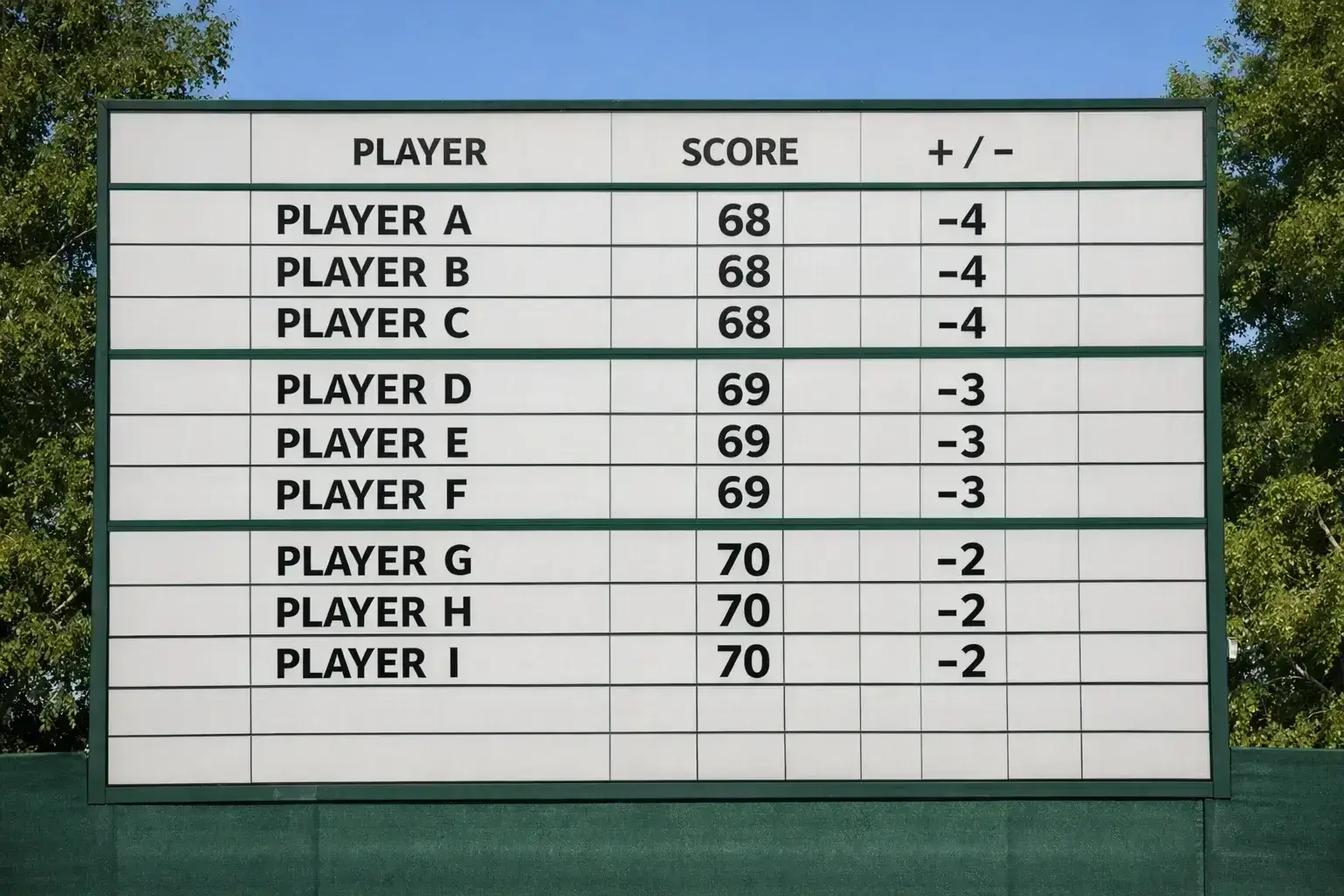
Finishing position bets—top five, top ten, top twenty, and similar markets—represent the most common source of dead heat situations in golf betting. These bets win when your selected player finishes at or above a specified position, and they encounter dead heat rules when multiple players tie for that threshold position.
The mechanics are straightforward in concept. If you bet on a player to finish top ten and they finish anywhere from first through ninth outright, you win at full odds with no dead heat involvement. If they finish tied for tenth or better with no tie complications at the tenth spot, you also win at full odds. But if multiple players share tenth place, dead heat rules determine your payout.
Why are ties so common at these threshold positions? Golf scoring naturally clusters players at similar totals, especially around cut lines and at middle-leaderboard positions. A tournament finishing with five players tied for seventh place is entirely normal, and when that happens, anyone holding top ten bets on those players faces dead heat reduction.
The frequency of dead heats increases as the position threshold rises. Top five bets encounter dead heats less often than top ten bets because fewer positions are in play. Top twenty bets encounter dead heats more often than top ten bets because the likelihood of ties somewhere in the 15th through 20th range is quite high. This probability curve should influence how you size bets across different finish position markets.
First Round Leader Bets
First round leader bets ask you to identify the player who will hold or share the lead after eighteen holes on Thursday. Dead heats in FRL markets occur whenever multiple players post the same low score in round one—a remarkably common outcome given the field size and scoring conditions.
Unlike four-round tournaments where 72 holes typically separate the field, single-round leaderboards frequently produce ties at the top. A 65 might be the low score of the day, but three or four players shooting 65 is more common than a single player standing alone. The condensed format simply does not provide enough scoring opportunities to differentiate players as effectively as a full tournament.
The dead heat frequency in FRL markets means that even when you correctly identify a first-round leader, you should expect reduced payouts more often than full payouts. This expectation should inform both your bet sizing and your expected value calculations for FRL positions.
Round Leader Bets
Round leader bets extend beyond the first round to any specified round—second round leader, third round leader, or fourth round leader. Each of these markets carries similar dead heat risk to FRL bets because single-round scoring produces ties frequently.
Later-round leader bets may actually carry higher dead heat risk than first-round leader bets because the cut reduces the field and concentrates quality players. When 70 players compete in round three compared to 156 in round one, the likelihood of multiple elite players posting identical scores increases.
Round-by-round scoring also tends to cluster as course conditions stabilize and players adjust to the setup. If the scoring average for round three is 70, many players will post scores between 68 and 72, and ties at 66 or 67 among the leaders become likely.
Why Outright Bets Do Not Have Dead Heats
Tournament winner bets avoid dead heat complications entirely because golf tournaments break first-place ties through sudden-death playoffs. When two or more players finish 72 holes at the same score, they return to the course and play additional holes until one player posts a lower score and wins outright.
This playoff mechanism means that every tournament produces a single winner, and every outright winner bet either wins at full odds or loses completely. The binary outcome eliminates dead heat risk from the most popular golf betting market.
The same principle applies to any market that ultimately resolves to a single winner: season-long futures like FedEx Cup champion, major championship winners, and similar markets where ties cannot persist. If a playoff or tiebreaker determines the final result, dead heat rules do not apply.
How Dead Heat Payouts Are Calculated
The Stake Division Method

The stake division method represents the standard approach used by most sportsbooks to calculate dead heat payouts. The concept is simple: your stake is divided among the tied players proportionally based on available positions, and the winning portion pays at full odds while the remaining portion loses.
Consider a top ten bet where your player ties for tenth with one other player. Two players share one position—tenth place. Your stake is divided in half: half is treated as a winning bet paying full odds, and half is treated as a losing bet returning nothing. If you bet $100 at +200 odds, you receive $150 total ($50 stake returned plus $100 profit on the winning half), compared to $300 total if no dead heat had occurred.
The calculation becomes more complex with more players tied. If three players tie for tenth in a top ten bet, only one of the three fills the tenth position. Your stake is divided by three: one-third wins at full odds, and two-thirds loses. A $100 bet at +200 odds returns approximately $100 total ($33 stake plus $67 profit), a dramatic reduction from the expected $300.
The formula can be expressed as: Payout = (Stake × Winning Positions / Total Tied Players) × (Odds + 1). This formula applies regardless of how many players are tied or how many positions are available for them.
The Odds Reduction Method
Some sportsbooks, particularly those based in the United Kingdom, use an odds reduction method rather than stake division. Under this approach, your full stake remains in play, but the odds are reduced proportionally based on the number of tied players.
Using the same example—a top ten bet with two players tied for tenth—the odds reduction method would halve your odds rather than halving your stake. A bet at +200 odds becomes effectively +100 odds with two players tied. Your $100 bet returns $200 total ($100 stake plus $100 profit), which happens to equal the stake division outcome in this simple case.
The outcomes differ slightly in complex scenarios and at certain odds levels, but both methods produce broadly similar results. The mathematical intent is identical: to proportionally reduce your return based on the probability that your specific player occupies the winning position among the tied group.
Most American sportsbooks use stake division, while stake division and odds reduction both appear among European operators. Checking your sportsbook’s specific dead heat policy before betting allows you to calculate expected outcomes accurately.
Dead Heat Calculator: Work Through It
Understanding dead heat math requires working through calculations until the logic becomes intuitive. Here is a systematic approach for any dead heat scenario.
Step one: Identify how many positions your bet covers at the threshold. A top ten bet covers one position at the tenth spot (positions one through nine win outright, only tenth involves potential dead heat complications at the boundary). A top five bet covers one position at the fifth spot.
Step two: Count how many players are tied at or near the threshold. If four players tie for eighth place in a top ten bet, all four finish in the top ten—no dead heat applies because all tied players fall within your bet’s winning range. But if four players tie for ninth, only two positions (ninth and tenth) are available for four players, triggering dead heat rules.
Step three: Calculate the proportion of your stake that wins. Divide available positions by tied players. Four players tied for ninth in a top ten bet means two positions divided by four players equals 0.5 or 50% of your stake wins.
Step four: Calculate your return. Multiply your stake by the winning proportion, then apply full odds to that amount, and add back the winning portion of your stake. Subtract the losing portion of your stake from this total if you want to calculate net profit rather than total return.
Real-World Dead Heat Examples
Top 10 Bet with 3-Way Tie for 10th

You bet $100 on a player to finish top ten at +180 odds. Your player finishes in a three-way tie for tenth place.
Three players share one available position (tenth), so your stake is divided by three. One-third of your stake ($33.33) is treated as winning, while two-thirds ($66.67) loses.
The winning portion returns: $33.33 × 2.80 (decimal odds equivalent of +180) = $93.33 total return on the winning third.
Your net result: $93.33 received minus $100 wagered equals a loss of $6.67.
This example illustrates a critical point: dead heats can transform winning bets into net losses. Your player finished in the top ten, your bet technically won, but after dead heat reduction you lost money. This outcome occurs when odds are not high enough to overcome the stake reduction from multiple tied players.
Top 5 Bet with 6 Players Tied
You bet $50 on a player to finish top five at +350 odds. Six players tie for third place.
Six players compete for three available positions (third, fourth, and fifth), so your stake is multiplied by 3/6 or 0.5. Half your stake wins, half loses.
The winning portion returns: $25 × 4.50 (decimal odds) = $112.50 total return.
Your net result: $112.50 minus $50 wagered equals profit of $62.50.
Despite heavy dead heat reduction, this bet remains profitable because the initial odds were high enough to absorb the 50% stake reduction. The lesson: higher odds provide buffer against dead heat impact.
FRL with 4 Players Tied for Lead
You bet $25 on a player to lead after round one at +4000 odds. Four players tie for the first-round lead at 64.
Four players share one position (first-round leader), so your stake is divided by four. One-quarter of your stake ($6.25) wins, three-quarters ($18.75) loses.
The winning portion returns: $6.25 × 41.00 (decimal odds) = $256.25 total return.
Your net result: $256.25 minus $25 wagered equals profit of $231.25.
Even with a four-way dead heat, this FRL bet produces substantial profit because the original odds were extremely long. FRL bets typically offer odds high enough that dead heat reduction still leaves meaningful profit when you correctly identify a leader.
Each-Way Bet Dead Heat Scenario
You bet $50 each way ($100 total) on a player at +2000 outright odds with 1/4 place terms for top five. Your player finishes in a two-way tie for fifth place.
The win portion ($50) loses because your player did not win the tournament.
The place portion ($50) encounters a dead heat. Two players share one position (fifth), so half your place stake wins. The place odds are +500 (one-quarter of +2000).
The winning place portion returns: $25 × 6.00 (decimal odds) = $150 total return on the place component.
Your net result: $150 received minus $100 total wagered equals profit of $50.
Each-way dead heats affect only the portion of the bet that encounters the tie—in this case, the place portion while the win portion simply lost.
Dead Heat Rules by Sportsbook
DraftKings Dead Heat Policy
DraftKings applies standard stake division dead heat rules. When players tie at a position that affects bet outcomes, the stake is divided proportionally based on available positions versus tied players, and the winning portion pays at full stated odds.
The policy applies uniformly across all golf markets including finishing positions, first round leader, and round-by-round leader bets. DraftKings does not offer alternative dead heat resolution options or markets that avoid dead heat reduction.
FanDuel Dead Heat Policy
FanDuel also uses stake division for dead heat calculations, matching the industry standard approach. Their policy language specifies that ties at any position affecting a bet’s outcome trigger proportional stake division.
FanDuel’s dead heat rules apply to all golf prop and finishing position markets. The sportsbook’s terms and conditions provide specific language about dead heat resolution that bettors can reference for detailed policy information.
BetMGM Dead Heat Policy
BetMGM employs stake division dead heat rules consistent with other major American sportsbooks. The proportional calculation divides stakes based on positions available versus players tied.
BetMGM occasionally offers specific markets labeled “including ties” that pay full odds when your player ties for a specified position, avoiding dead heat reduction. These markets typically offer shorter odds than standard finishing position bets to compensate for the reduced risk.
bet365 Dead Heat Policy
bet365 uses dead heat rules common among UK-based sportsbooks, which may apply either stake division or odds reduction depending on the specific market and circumstances. Their golf markets generally follow stake division methodology.
The sportsbook offers extensive golf betting markets including each-way options with clear place terms. bet365’s customer service can clarify specific dead heat policies for any market where the standard rules seem ambiguous.
Sportsbooks That Pay Ties in Full
No major sportsbooks pay ties in full as standard policy for finishing position markets—the economics would not support sustainable odds offerings. However, some books offer specific “including ties” or “tied counts” markets at adjusted odds that provide full payout when your player ties for a qualifying position.
These markets deserve consideration when available, particularly for positions where ties occur frequently. The reduced odds may actually represent better expected value than standard markets once dead heat probability is factored into the calculation.
Strategies to Minimize Dead Heat Impact
Betting “Including Ties” Markets
When sportsbooks offer “including ties” markets, evaluate them carefully against standard finishing position bets. Calculate the expected value of each option by estimating dead heat probability and comparing the effective odds.
If a standard top ten bet offers +200 odds but you estimate 25% probability of a dead heat that would reduce your average payout to roughly +150 effective odds, an “including ties” market at +160 might actually represent better value despite the lower stated odds.
The math favors “including ties” markets when dead heat probability is high—typically at larger position thresholds like top twenty or in markets like FRL where ties occur frequently.
Adjusting Bet Selection
Some finishing positions carry higher dead heat risk than others based on typical leaderboard distributions. Positions where players tend to cluster—like tenth place, where the cut-related separation creates natural bunching—encounter dead heats more frequently than positions where players spread out.
Adjusting your bet selection toward positions with lower dead heat probability can improve expected value without sacrificing opportunity. A top seven or top eight bet might offer better effective odds than top ten after accounting for dead heat risk, even if the stated odds are somewhat shorter.
Similarly, selecting players whose scoring patterns suggest definitive finishes rather than tie-prone outcomes can marginally reduce dead heat exposure. Consistent players who avoid big numbers tend to finish in clearer positions than volatile players who might post anything from 65 to 75 in a round.
Factoring Dead Heat into Expected Value

Every golf bet involving finishing positions should incorporate dead heat probability into expected value calculations. The stated odds on a top ten bet do not represent your true expected return—the effective odds after accounting for likely dead heats are always somewhat lower.
Estimating dead heat probability requires historical analysis of how often ties occur at specific positions. Data from past tournaments shows that certain positions consistently produce ties while others rarely do. Building these probabilities into your handicapping model produces more accurate expected value estimates.
The adjustment matters most for marginal betting decisions. A bet that appears slightly positive expected value at stated odds might actually be negative expected value after dead heat adjustment—or vice versa for bets that initially appeared marginal.
When Dead Heat Risk is Acceptable
Dead heat risk becomes more acceptable as odds increase. A +5000 longshot that encounters a two-way dead heat still returns +2500 effective odds—far better than most winning outcomes at shorter prices. The high initial odds provide buffer against stake reduction.
FRL bets exemplify acceptable dead heat risk. The expected frequency of ties is high, but the typical odds of +3000 to +8000 mean that dead heat reductions still produce meaningful profits. Bettors who avoid FRL markets entirely due to dead heat concerns forfeit value that exists despite the reduction.
Similarly, each-way bets on longshots tolerate dead heat impact well. When your player at +3000 outright with +750 place odds encounters a dead heat on the place portion, the remaining return still exceeds most alternative bet outcomes.
Dead Heat in Each-Way Bets
How Each-Way Place Portion is Affected
Each-way bets split your stake between win and place components, and dead heat rules apply independently to whichever component encounters a tie. If your player wins outright, no dead heat applies to either component. If your player places but does not win, dead heat rules apply only to the place component if relevant ties exist.
The place portion is far more likely to encounter dead heat situations than the win portion because place ranges span multiple positions where ties commonly occur. A top five place market might encounter dead heats at fourth or fifth position, while the win portion only involves outright first place which cannot tie due to playoffs.
Calculation Example
You bet $100 each way ($200 total) on a player at +3000 outright with 1/4 odds for top eight places. Your player finishes in a three-way tie for seventh.
Win component: Loses entirely because your player did not win. You lose $100.
Place component: Three players tie for seventh, but three positions (seventh and eighth) are available among the tied players. Wait—this needs clarification. If three players tie for seventh, they occupy seventh, eighth, and ninth in the final standings. With place terms covering top eight, two of the three positions (seventh and eighth) count as placing.
Your $100 place stake is proportioned: 2/3 wins at +750 place odds (one-quarter of +3000), 1/3 loses.
Winning place returns: $66.67 × 8.50 = $566.67
Net result: $566.67 minus $200 total wagered = $366.67 profit.
The each-way structure means dead heat affects only the relevant component while the other component resolves normally.
Strategic Implications
Each-way bets on longshots provide natural dead heat protection because the high underlying odds produce meaningful returns even after reduction. The place component especially benefits from this dynamic since place odds, while lower than outright odds, remain substantial enough to absorb dead heat impact.
Conversely, each-way bets at shorter prices offer less dead heat protection. When place odds are only +200 or +300, dead heat reduction can easily turn a technically winning place bet into a net loss on that component.
Common Dead Heat Questions
Can a dead heat result in a loss?
Yes. When odds are not high enough to overcome stake reduction, a technically winning bet returns less than the original stake. This outcome occurs most often with two or more players tied for a position at modest odds—a top ten bet at +150 odds with a three-way tie for tenth returns approximately $83 on a $100 bet, a net loss of $17 despite your player finishing in the top ten.
Do all sportsbooks use the same rules?
Most sportsbooks use equivalent dead heat rules that produce identical or nearly identical outcomes, but some variation exists in terminology and specific calculation methods. Stake division and odds reduction produce slightly different results in certain scenarios. Always verify your sportsbook’s specific policy in their terms and conditions.
How common are dead heats in golf?
Dead heats occur frequently enough to materially impact expected value calculations. Estimates suggest that 20% to 30% of top ten bets encounter some form of dead heat, with higher frequencies for top twenty bets and FRL markets. The precise frequency varies by field size, course difficulty, and scoring conditions.
Is there a way to avoid dead heats entirely?
Outright winner bets avoid dead heats because playoffs resolve ties for first place. Some sportsbooks offer “including ties” markets that pay full odds regardless of ties. Otherwise, dead heat risk is inherent to finishing position and leader markets, and the most effective strategy is accounting for this risk in your expected value calculations rather than attempting to avoid it entirely.
Conclusion
Dead heat rules represent a fundamental aspect of golf betting that every serious bettor must understand and incorporate into their decision-making process. The reduction in payouts when multiple players tie for key positions affects expected value calculations for all finishing position and leader markets.
The calculation mechanics—whether stake division or odds reduction—produce proportional adjustments that reflect the probability of your specific player occupying the winning position among tied competitors. Higher initial odds provide better protection against dead heat impact, making longshot bets more tolerant of ties than bets at shorter prices.
Strategic responses to dead heat risk include seeking “including ties” markets when available, adjusting position selection toward thresholds with lower tie frequency, and building dead heat probability estimates into expected value calculations. These adjustments ensure that your betting decisions account for realistic outcome distributions rather than assuming you will always receive full stated odds on winning bets.
Stay updated with the latest sportsbook rules and betting strategies on the best golf betting site.
