
Golf Betting Odds Formats and Lines
 Available in US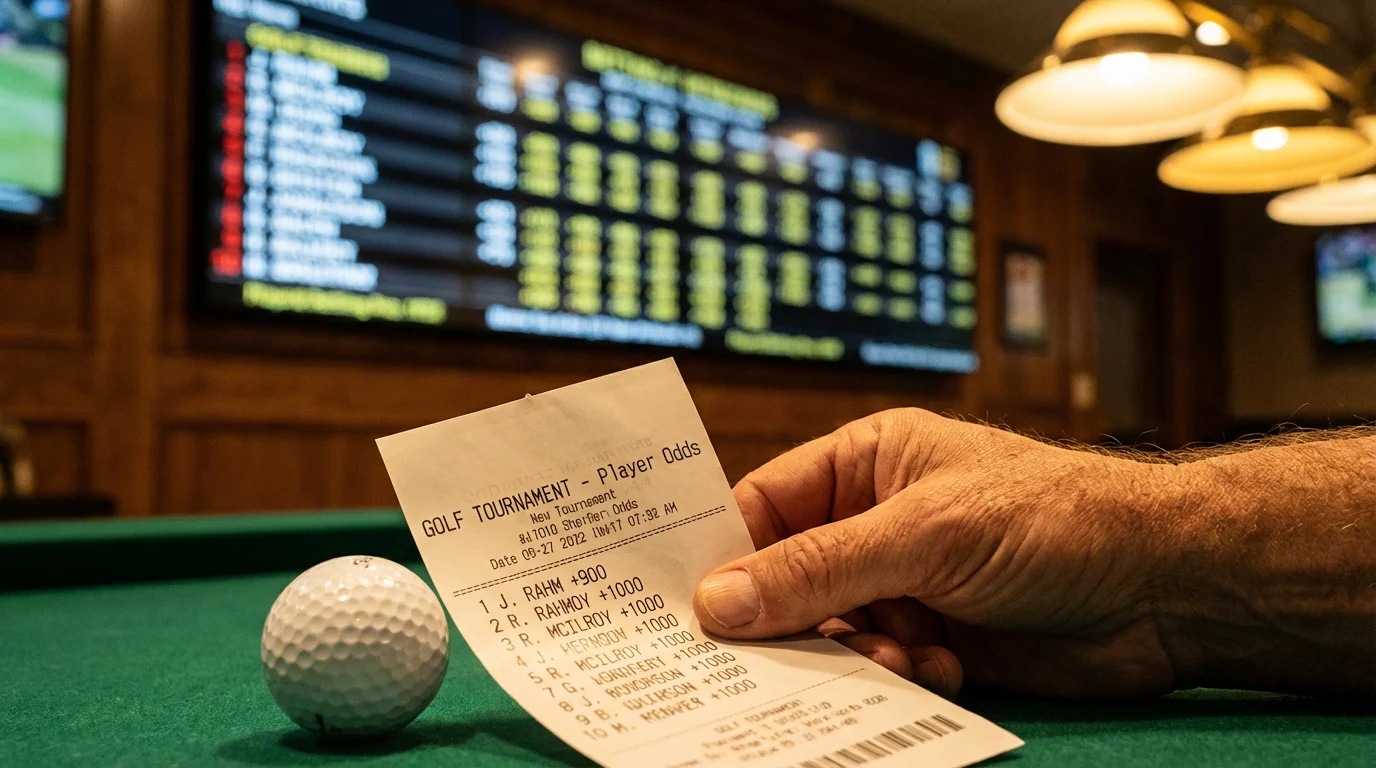

Golf odds look intimidating until they don’t. The difference between a bettor who stares at a tournament board in confusion and one who spots value in seconds comes down to understanding three formats: American, decimal, and fractional. Every sportsbook on the planet uses at least one of these, and most offer all three. Once you can read and convert between them, you stop guessing and start calculating.
The challenge with golf is scale. A typical NFL game has two sides. A PGA Tour event might have 156 players, each with their own outright odds, and those numbers move constantly as the market reacts to tee times, weather forecasts, and practice round reports. Whether a sportsbook lists Scottie Scheffler at +800, 9.00, or 8/1, they’re saying the same thing — but the format you’re most comfortable with determines how quickly you can evaluate the bet.
This guide breaks down all three formats with real-world golf examples, teaches you to convert between them without a calculator (mostly), and explains why the format you choose matters more than you might think.
American Golf Betting Odds System
American odds are the default at U.S.-facing sportsbooks, and they revolve around the number 100. Positive numbers tell you how much profit you’d earn on a $100 stake. Negative numbers tell you how much you need to risk to profit $100. In golf betting, you’ll almost exclusively see positive numbers for outright winner markets because no golfer in a full field is a true “favorite” the way a -300 NFL team would be.
When you see Rory McIlroy listed at +1400 for a tournament, that means a $100 bet returns $1,400 in profit plus your original $100 back, for a total payout of $1,500. Scottie Scheffler at +600 means $100 wins you $600 in profit. The lower the positive number, the shorter the odds, which means the sportsbook considers that player more likely to win. A golfer at +10000 is a 100-to-1 longshot — your $100 would return $10,000 in profit if they pulled it off.
Where negative American odds do appear in golf is in head-to-head matchup markets and certain prop bets. If a sportsbook offers a 72-hole matchup between Scheffler (-140) and McIlroy (+120), you’d need to bet $140 on Scheffler to profit $100, while a $100 bet on McIlroy profits $120. The math here is identical to any other sport, but these markets are far more common in golf than casual bettors realize, and they often offer better value than outright winner bets.
One quirk of American odds in golf: because fields are large and true probabilities are low, the numbers can get unwieldy. Seeing +25000 next to a little-known player doesn’t intuitively communicate much. You know they’re a longshot, but how long exactly? That’s where converting to implied probability helps — and why many serious golf bettors switch to decimal format for faster evaluation.
Decimal Odds: The Multiplier Approach
Decimal odds are the standard across European, Australian, and Asian sportsbooks, and they’re arguably the most intuitive format for golf betting. The number represents your total return per unit staked — stake included. If a player is listed at 9.00, every $1 you bet returns $9 total. Your profit is the decimal minus one, multiplied by your stake.
The beauty of decimal odds for golf is simplicity when comparing a large field. Scan a list and the math is instant: 15.00 means fifteen times your money back, 51.00 means fifty-one times. There’s no mental gymnastics with plus signs or fractions. When you’re scrolling through 156 players trying to find where the value sits, the speed of decimal comparison is a genuine edge. Professional golf bettors who work across multiple sportsbooks almost universally prefer decimal format for this reason.
Decimal odds also make it trivially easy to calculate implied probability, which is the sportsbook’s estimated chance of that outcome occurring. The formula is: Implied Probability = 1 / Decimal Odds. A player at 11.00 has an implied probability of 1/11 = 9.09%. A player at 34.00 has an implied probability of 1/34 = 2.94%. When you can glance at a number and immediately estimate the probability, you’re working faster than most of the market.
One thing to watch with decimal odds: the difference between 1.91 and 2.00 is much larger than it appears. In matchup betting, where both sides hover around the 2.00 mark, small decimal differences translate to meaningful changes in implied probability and expected value. A head-to-head bet priced at 1.87 implies a 53.5% chance, while 2.10 implies 47.6%. In outright markets with bigger numbers, the differences matter less on a per-bet basis, but they compound over a season of wagering.
Fractional Odds: The Traditional Format
Fractional odds are the oldest format and remain dominant in the UK and Ireland, especially at traditional bookmakers. They express your profit relative to your stake as a ratio. A player at 8/1 (read “eight to one”) returns $8 profit for every $1 wagered, plus your original dollar back. A player at 14/1 pays $14 profit per $1 staked.
Golf betting and fractional odds have a long shared history because the sport’s betting culture grew in the British Isles alongside horse racing, where fractional odds are deeply embedded. When you see odds like 16/1, 33/1, or 100/1 on a tournament outright board, you’re looking at the same format that’s been used at bookmakers since long before online sportsbooks existed. For round numbers, fractional odds are clean and intuitive — most people understand “25 to 1” without any explanation.
The complication arises with non-round fractions. A matchup bet priced at 5/6 or 4/5 requires more mental processing than its decimal equivalent of 1.83 or 1.80. When one side of a head-to-head is listed at 10/11 and the other at evens (1/1), converting to decimals (1.91 and 2.00) makes the comparison faster. Fractions like 11/8 or 13/8 are perfectly logical once you’re used to them — 11/8 means $11 profit on an $8 stake — but they create an unnecessary speed bump for bettors accustomed to other formats.
Another area where fractional odds still dominate is each-way betting, a format particularly popular for golf in the UK market. Each-way terms are traditionally quoted alongside fractional odds — for example, “25/1, each-way 1/5 odds, top 8.” This means the place portion of your bet pays at one-fifth of 25/1 (which is 5/1) if your player finishes in the top 8. The entire each-way structure was built around fractional notation, and while decimal sportsbooks offer equivalent functionality, the language around each-way remains firmly fractional.
Converting Between Formats
Switching between formats is straightforward once you know the relationships. Here are the key conversions:
- American to Decimal: For positive American odds, divide by 100 and add 1. So +800 becomes (800/100) + 1 = 9.00. For negative odds, divide 100 by the absolute value and add 1. So -150 becomes (100/150) + 1 = 1.67.
- Decimal to American: For decimals above 2.00, subtract 1 and multiply by 100 to get the positive American number. So 9.00 becomes (9.00 – 1) x 100 = +800. For decimals below 2.00, divide -100 by (decimal – 1). So 1.67 becomes -100 / 0.67 = -149 (rounded to -150).
- Fractional to Decimal: Divide the first number by the second and add 1. So 8/1 becomes (8/1) + 1 = 9.00. And 5/4 becomes (5/4) + 1 = 2.25.
- Decimal to Fractional: Subtract 1, then express as a fraction. So 9.00 becomes 8/1. And 2.25 becomes 5/4.
In practice, most sportsbooks let you toggle between formats with a single click, so memorizing conversion formulas matters less than understanding what the numbers mean. The real skill is knowing that +1200, 13.00, and 12/1 are the same thing, so you can compare prices across books that default to different formats without losing time.
For tournament outright betting, a quick mental shortcut works well: take the American odds, drop the zeros, and you have a rough fractional equivalent. +1400 is roughly 14/1. +2500 is roughly 25/1. This breaks down for non-round numbers and matchup markets, but for scanning an outright board it saves valuable seconds.
Why Your Format Choice Matters More Than You Think
Choosing a default odds format isn’t just personal preference — it affects how efficiently you process information, which directly impacts your betting decisions. Research in behavioral economics shows that the way numerical information is framed influences decision-making, even among experienced professionals. A golfer at +2000 feels different from the same golfer at 21.00 or 20/1, even though the payout is identical.
Decimal format forces you to think in terms of total return, which naturally connects to expected value calculations. American format anchors you to a $100 benchmark, which can make longshots feel more attractive (“+5000 sounds amazing”) without fully registering how unlikely the outcome is. Fractional odds sit somewhere in between, offering a clean profit-to-stake ratio that works well for mental math on round numbers but becomes cumbersome in more complex markets.
The best practice for serious golf bettors is to work primarily in decimal for analysis and comparison, but remain fluent in all three. You’ll encounter American odds on DraftKings and FanDuel, fractional odds on Bet365 and William Hill (for UK golf markets), and decimal odds on Pinnacle and most Asian-facing books. Being format-agnostic means you never miss value because a price was displayed in an unfamiliar way.
The Number Behind the Number
Every set of odds, regardless of format, carries an implied probability — the market’s estimated likelihood of an outcome. But here’s the part most guides skip: the sum of all implied probabilities on a board always exceeds 100%. That excess is the overround, also called the vig or juice, and it’s how sportsbooks make money.
In a typical PGA Tour outright market, the overround might sit between 115% and 140%, depending on the book and the size of the field. That means if you added up the implied probabilities for all 156 players, you’d get something like 130%, not 100%. The extra 30 percentage points represent the sportsbook’s built-in margin. Different books set different overrounds, which means the “true” implied probability of any given player is lower than the raw number suggests.
Understanding overround is the bridge between reading odds and actually betting profitably. When you strip out the vig from a sportsbook’s odds and compare the adjusted probabilities to your own assessment of each player’s chances, you’re doing what sharp bettors do: looking for discrepancies between the market’s price and reality. That process starts with reading the odds correctly — and now you can.
